
How to Set Up a Recovery Pen
- Tiffany Downing, RVT & Lauryn Harker, CCAT, CCRP, RVT, CAPM
- Mar 4
- 12 min read
Updated: May 8
If your pet is unable to rise, stand, or walk, they are considered a recumbent patient or sometimes referred to as a “down dog”. If your dog can rise and stand but can’t walk, they’re considered non-ambulatory. Either way, caring for a dog that cannot move about on their own is a challenging endeavor which can be more difficult due to your dog’s size, temperament, and level of debilitation. Depending on their diagnosis, you may be responsible for some or all of your dog’s most basic bodily functions – eating, drinking, urinating/defecating, maintaining Range of Motion, minimizing muscle atrophy, preventing bed sores, and even providing mental stimulation. If your pet is expected to get better, these responsibilities may be temporary, but other conditions may require you to continue providing this level of support for the remainder of your pet’s life.
While the information in this article is focused on recumbent pets, it can also be applied to veterinarian-directed crate rest, regardless of your pet’s mobility status.
Conditions commonly in need of recumbent/non-ambulatory care include:
Acute Non-Compressive Nucleus Pulposus Extrusion (ANNPE)
Geriatric Sarcopenia
Until your dog can resume independent mobility, you’ll need to make some adjustments at home in order to keep them safe, clean, and comfortable so we’re sharing all the best tips and tricks for creating a recovery pen for your dog with real life examples and options to fit your dog’s size and medical condition.
Why Does Your Dog Need A Recovery Pen?
The short answer is that it will help your dog recover faster, reduce risk of complications, and make it easier for you to properly care for them.
The purpose of the recovery pen is to limit your pet’s activity, reduce overexcitement or stress, & provide a clean, comfortable environment that maximizes healing.
If your dog is allowed to be more active than their condition allows, they are likely to re-injure themselves or otherwise worsen their condition. Similarly, if they don’t have enough room to move and stretch, they can quickly lose muscle mass and range of motion that are integral for any chance of recovery.

If they cannot reposition themselves on their own, they are at risk for complications like decubital ulcers aka “bed sores” which can severely impact their health and ability to recover. If your dog is incontinent, you’re going to want to make cleaning up as fast and simple as possible to reduce the burden of care on you and reduce your dog’s risk of skin and urinary tract infections.
Preventing free access to your home helps avoid serious safety hazards.
Sometimes, other pets in the household can be a danger to your recumbent dog, whether it's an unintentional jostle or outright aggression. If your dog is recovering from a spinal injury, a fall down the stairs or even just traversing the furniture can mean the difference between permanent paralysis and successful recovery.
If you have to clean up potty accidents all over the house, you are likely to develop compassion fatigue much more quickly, reducing your ability to effectively care for your pet, your family, and yourself.
Influential Factors
The reason for and severity of your dog’s loss of mobility will directly influence how you’ll need to prepare their recovery pen, as well as how that space might evolve in the coming days, weeks, or months.
These questions will help guide you through the process:
Is your dog expected to get better?
Can they keep themselves upright, sit, or stand? Do they make any attempts to walk?
Can they eat and drink on their own?
Can they control when and where they urinate or defecate?
How much supervision are you able to maintain?
Does your dog respect boundaries like baby gates or pens?
Keep your answers in mind as we delve into the details. Other influential factors to consider include your dog’s breed, age, body weight, if they’ve had surgery, and your physical capability to care for them.
Early vs. Late Stages of Rest
If your dog is expected to get better, your recovery pen will need to be modified as their abilities and needs change. The goal is to maximize safety and comfort while still providing enough space to encourage movement as appropriate.
Early Rest is generally considered the period of time when your pet is the most delicate and/or debilitated. During this stage, the recovery pen will be small and require that you can move your pet in and out of it in a manner that is safe for you and your pet.

Late Rest can vary pending your pet’s condition and your veterinarian’s recommendations, but this typically begins a few weeks after your pet’s initial injury or surgery.
You should not switch to a late rest recovery pen until your veterinarian advises you to do so.

During this stage, your pet is likely making more attempts to move and we want to encourage them to continue doing so while preventing potential complications from over activity.
Recovery Pen Basics
Your dog’s recovery pen will be their own little world for most of the time and they will use this space for eating, drinking, rest, and eventually, attempts at walking.
Regardless of the stage of rest, your pet’s recovery pen should always:
Rest on a flat, level surface
Be in a temperature controlled space
Be lined with easily cleaned materials that provide good traction & padding
Have clean water available in a bowl that can’t be spilled
Securely contain your recumbent pet while keeping other pets & small children out
Be located in a spot that is neither too isolated, nor too overstimulating
Include some element of privacy for your dog
Be kept clean, dry, & free of pet waste
Have a floor level entry so your pet doesn’t have to step over anything
Allow you to easily get your pet in & out without twisting or pulling on their body
Early Rest Pen
NO walking space! Just large enough that your pet can lie fully stretched out, sit, stand, turn around, and eat/drink with ease but no larger.
Late Rest Pen
Slightly expand upon the Early Rest Pen to add a standing area just large enough for your pet to take 2-5 steps away from their bed, but no larger.
While expandable pens work well for most pets, special considerations may need to be made for some pets. If your dog is an escape artist, you may need to utilize a crate instead of a pen and then use a larger crate once they have entered late stage rest.

Giant breeds may benefit from a small recovery room instead of trying to squish them into a pen that is too small or short. Should that be the case, ensure that all furniture is removed and that the doorway can be securely closed or blocked off.
Recovery rooms are only appropriate for dogs that are too large to use a pen & should still follow all of the rules for a typical recovery pen.
Linings, Layers, & Linens
When lining your pet’s recovery pen, it's a good idea to utilize multiple layers of varying materials, especially since many recumbent pets have some form of incontinence. All layers should be chosen with consideration for your pet’s comfort and safety, their stage of recovery, as well as ease of cleaning or replacement.

Protective Layers
This first layer is intended to prevent any damage to your floor and stop the pen from sliding around. Commonly used materials include plastic sheeting, rubber/yoga mats, and waterproof blankets.
Absorbent Layers
If there is any chance your dog will urinate, defecate, vomit, or spill water in their recovery pen, absorbent layers are a must. Options vary widely depending on budget and what is easiest for you to use. If you don’t mind frequent washing and drying, thick towels or blankets may work well for you. Alternatively, disposable potty pads make for quick and easy clean up, are available in a variety of sizes, and can be purchased in bulk. If your pet has trouble controlling their bowels or bladder, be prepared to change linings out multiple times a day regardless of what material you’ve chosen or if your pet is wearing a diaper.
Early Rest Bedding
Because early rest pens should only be wide enough for your pet to lie fully stretched out, the entire floor of the pen can be considered a bed and should be relatively level.
Because early rest pens should only be wide enough for your pet to lie fully stretched out, the entire floor of the pen can be considered a bed and should be relatively level.
At this stage, our primary goal is to ensure there is enough padding to support your pet’s body & protect them from injury if they roll over or stumble.
At minimum, bedding should be 1-2 inches thick for every 40 lbs of body weight. Since there should be no room inside the pen for your pet to get off the bedding, you are free to make the bed as thick as is needed for comfort and safety.

Additional padding around the edges of the pen is strongly recommended to keep your pet from getting stuck up against a wall.
The easiest way to do this is to place rolled towels or crib bumpers around the inner perimeter of the pen. Similarly, rolled towels or bolster pillows can be placed directly against the body to prevent pets from rolling over or otherwise changing position.
Insufficient padding can result in stiffness, soreness, facial injuries, & decubital ulcers (bed sores).
In addition, pets that get stuck between their bed & the pen wall frequently panic & injure themselves.
Late Rest Bedding & Walking Area
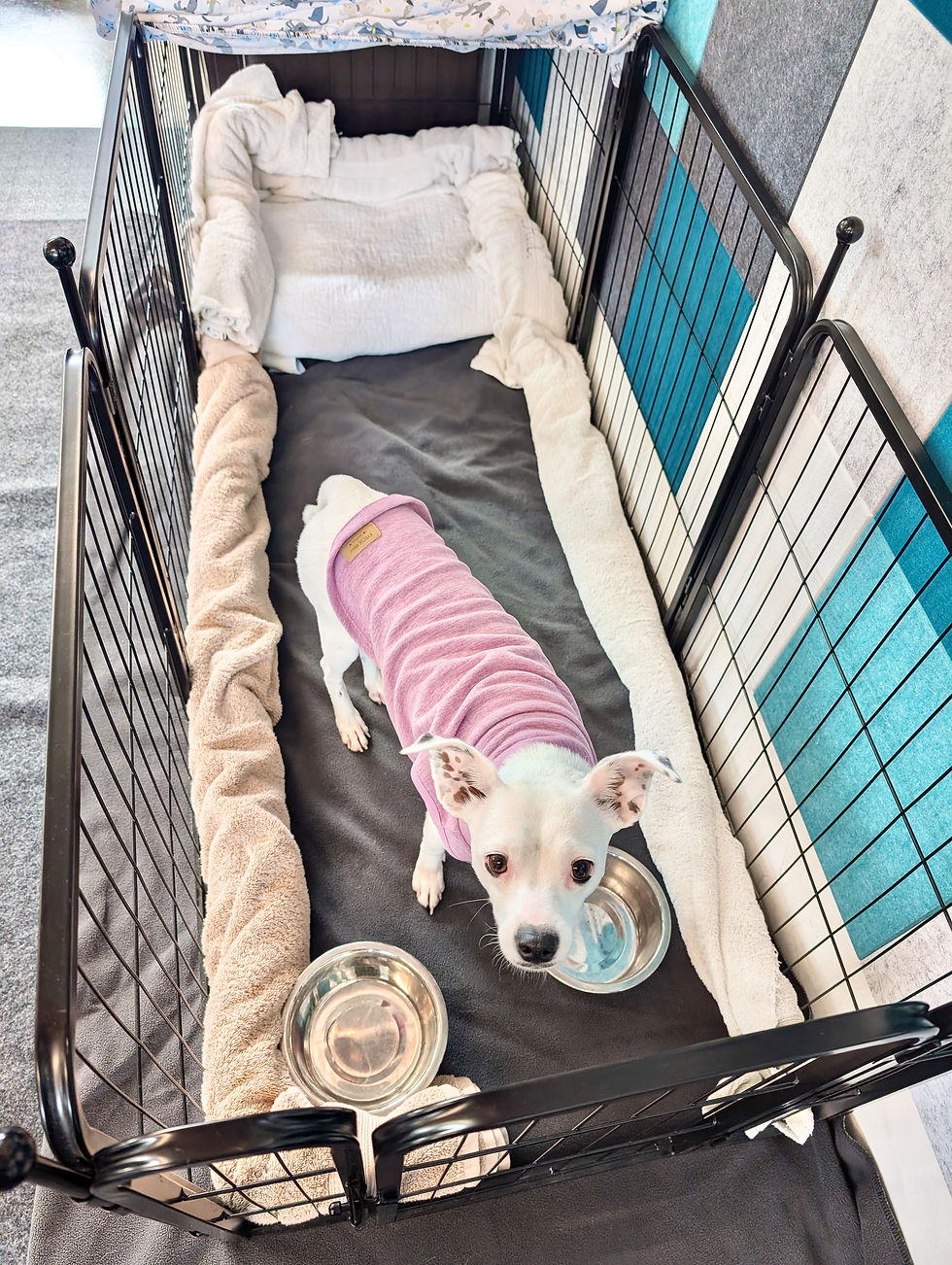
Late rest patients still need a bed area that adequately cushions their body and is large enough for them to lay fully outstretched upon, but now that movement is encouraged, we’ll need to add room for them to walk around inside their pen.
First and foremost, there should be minimal height difference between your pet’s bed & walking area.
This is to ensure they can get on and off with ease and reduce risk of falling. Generally speaking, beds should be no more than 2 inches high for small dogs or 4 inches high for large dogs.
For the walking area, you’ll need to provide a soft layer that provides good traction on top of the protective and absorbent layers. Avoid anything that wrinkles easily or slides. Common materials include terry towels, fleece blankets, low pile rugs with rubber backing, and yoga mats.
Special Considerations for Linings & Bedding
If your pet is frequently soiling their dog bed, it can be helpful to wrap the inner filling in plastic, then put the outer bed covering back on. It’ll be much easier to clean, especially if you have more than one cover for the bed.
Even soft materials can still cause injury

Be mindful that soft materials can still cause injury. Skin abrasions and excessively worn toenails can occur if your pet is dragging themselves across carpet or rough towels. Blankets and towels with holes can be a serious safety concern. It’s not uncommon for animal toes and nails to get stuck in those holes and as the pet tries to get free, that fabric can get twisted around the toe and cut off circulation. For this reason, it's best to avoid knit/crochet blankets and replace any towels or blankets that have torn.
If your pet tends to chew up bedding, you will need to find alternative ways to provide adequate padding while preventing your pet from eating anything they shouldn’t. Sometimes, it’s enough to have the layers laid flat and extended beyond the walls of the bed so that there are no edges for your pet to grab.
As long as your method is equally safe & comfortable, you’ve succeeded!
It can take a little trial and error to find what works for you and your pet. You might try out different beds or layer materials in a different order than our examples. If you’re not sure about an alternative option, reach out to us or your veterinarian first.
What else goes in the Recovery Pen?
Food bowls can be removed as needed, but water should always be kept available. It’s best to secure all bowls by surrounding them with towels or using bowls that can be clipped to the side of the pen. Some pets benefit from having their bowls slightly elevated off the ground, but always ask your pet’s veterinarian or Rehab specialist before doing this to ensure it is appropriate for your pet and to confirm what height is safest.
Regardless of the method you choose, just make sure it’s easy for your pet to access & that any spills are cleaned up quickly.

While you might be inclined to include your pet’s favorite toys, take care with what you choose to add and when. Toys can bring your pet joy, but they can also be a tripping hazard or encourage more activity than is safe.
If your pet has a delicate spinal condition, such as Intervertebral Disc Disease, no tug toys or vigorous toy shaking should be permitted.
As with any pet, be mindful of leaving toys unattended with your pet. Life in the recovery pen can get boring, especially if you’re not around to keep your pet company. If there’s a risk your pet might eat their toy, only give it to them when you are available to supervise.
Emotional Wellbeing
Pets experience significant distress when their mobility is compromised and for some pets, this can be compounded by being confined. Fortunately, there’s a lot you can do to make the experience more pleasant for your dog and promote the relaxation and rest they need to heal.
Start Positive
Your dog is an emotional creature and looks to you for guidance on how to respond to new things. Seeing your furry best friend struggle with pain or lack of mobility can instill feelings of sadness and frustration for you, but we can’t overstate how important it is for you to keep your attitude positive when around your pet.
When you introduce your pet to their recovery pen, make sure it’s a good experience!
Use their favorite bed or blankets. If you can time the introduction to align with their next meal, have that waiting in the pen for them. Spend some time with them as they check out their new space and calmly use lots of praise to help them understand that this is a good thing. Visit with them often and don’t make a big show when you walk away from the pen. Just calmly go about your day so you don’t emphasize that you’re leaving.

If your dog is particularly food motivated, it might be helpful to give them a little snack every time you put them back in the pen. Just make sure that you never reward anxious behavior (such as whining or barking) and always include those calories when measuring their food for the day as any excess body weight will drastically impact your pet’s ability to get back on their paws. If you’re not sure how much they can have, ask the CROC team or your primary veterinarian.
Pen Location & Privacy
The location of your pet’s recovery pen can have a huge impact. You don’t want to leave your pet feeling isolated from the family but you also don’t want them to get overly excited from too much going on around them.
The goal is for your pet to rest, which requires a calm, peaceful environment that promotes as much sleep as possible.
If your pet is the type to follow you around the house wanting to be involved in everything you’re doing, they’ll probably appreciate their pen being in the area where you and your family spend the most time. Some even appreciate having multiple pens around the house so that you can bring them along to whatever area you’ll be in.

If your dog is more aloof or nervous, they might do better in a quieter part of the house where they don’t feel so overstimulated & exposed.
Keeping the TV or music playing at low volume can help drown out any noise that might overexcite your pup, like the doorbell or other dogs barking nearby. If your pup is doorbell reactive, you may want to put up a “shhh, please don’t ring the doorbell” sign at your front door. Even if your pup is shy in nature, make sure to visit with them often so you can make sure they have everything they need and don’t feel completely alone. Dogs are social animals after all, even if some are more introverted than others!

As den animals, most dogs appreciate some semblance of privacy.
Covering part of the pen with a bed sheet or blanket can help them feel like they have a little den of their own to retreat to. Choosing a spot with a consistently comfortable temperature also goes a long way to helping your pet relax, so make sure to avoid drafty areas or places that warm up with a lot of direct sunlight.
Mental Stimulation
Since your pet can’t burn through pent up energy with exercise, this energy can manifest as anxiety and frustration.
Keeping their brain busy not only helps release that excess energy, but it's also a significant contributor to cognitive & emotional health for all dogs.
You can provide mental stimulation with new toys, games, food puzzles, and teaching or practicing tricks that require minimal movement. Delivering their meals to them in novel ways is a super easy way to do this and can be as simple as freezing it inside a kong toy, using a snuffle mat, or making them work through a food puzzle to get it.
If the weather allows and your dog can remain calm, some dogs really appreciate some supervised time in a pen outside to get some fresh air and sunlight. Just make sure that the outdoor pen follows the same rules as the recovery pen and your pet is not left out in overly hot, cold, or wet weather.
Questions?
The CROC Team is always happy to help you with your pet’s recovery pen!
Remember that every pet is different and it might take you a little bit to find the exact configuration that works best for you and your pet. The goal is to make sure your pet only moves as much as is safe and they are comfortable enough to rest so they can heal.


