
Recumbent/Non-Ambulatory Care
Updated: May 11

If your pet is unable to rise, stand, or walk, they are considered a recumbent patient or sometimes referred to as a “down dog”. If your dog can rise and stand but can’t walk, they’re considered non-ambulatory. Either way, caring for a dog that cannot move about on their own is a challenging endeavor which can be more difficult due to your dog’s size, temperament, and level of debilitation. Pending the reason for your dog’s condition, you may be responsible for some or all of your dog’s most basic bodily functions – eating, drinking, urinating/defecating, maintaining Range of Motion, minimizing muscle atrophy, preventing bed sores, and even mental stimulation.
We’re diving into all the basics you’ll need to know as you care for your pet at home, as well as common problems so you’ll know what to watch out for, why it happens, how to prevent them, & what to do if they occur.
While the information in this article is focused on recumbent pets and particularly those that suffer from neurological conditions, it can also be applied to any pet with compromised mobility.
Conditions commonly in need of recumbent/non-ambulatory care include:
Acute Non-Compressive Nucleus Pulposus Extrusion (ANNPE)
Geriatric Sarcopenia
Nutrition & Body Condition
The recumbent dog’s body condition can be tricky to maintain and there may be some trial and error to meet their nutritional requirements. To set your pet up for success, you will need to adjust their diet to match their activity level and rehabilitation needs.
Why Nutrition Matters
Dogs that aren’t moving on their own quickly begin to experience muscle atrophy, where the muscle wastes away from disuse. Inactivity also means that they are prone to gaining weight in the form of fat. More weight to haul plus weaker, wasting muscles is not an equation for recovery.

However, inadequate nutrition can be just as harmful. The body cannot heal or build muscle if we don’t give it the building blocks it needs to do so. In addition, muscle and fat act as cushioning for the body. The more that is lost, the more prominent skeletal features become, and the higher the risk for decubital ulcers (bed sores). Lastly, if your pet has lost bowel control, diet can mean the difference between a quick clean up or a bath and full bedding swap out.
Everything your pet eats, including treats, table scraps, dental chews, and anything else in addition to their regular food must be factored into their daily caloric allowance and nutritional requirements.
All calories count!
Treats are not nutritionally balanced to provide your dog with everything they need, so the majority of your dog’s calories need to come from an AAFCO approved diet to avoid any nutritional deficits that could cause serious illness.
As nutrition is part of your pet’s Rehab Consultation, the CROC medical team will provide you with a clear outline of how much food and water your dog will require each day and how many feeding sessions to split that amount into. On occasion, we will recommend adding a veterinarian prescribed muscle building supplement to a patient’s diet, as it can help prevent muscle loss and promote muscle growth. Visit our article Body Condition Score & Canine Weight Loss to learn more about maintaining your pet's weight. You can also reach out to your primary veterinarian or a veterinary nutritionist for guidance and prescription diets.
How to Feed Your Pet

If your pet is unable to eat or drink on their own, they may require hospitalization for intravenous fluids and possibly even a feeding tube. Sometimes, when patients are otherwise stable, owners can be taught how to feed their pet using the feeding tube and can continue to do so at home with the goal being that the dog will eventually be able to eat on their own so the feeding tube can be later removed. If your dog is able to swallow or chew, then you may be able to hand or syringe feed them at home, but refer to your veterinarian to ensure your pet’s safety.
If your dog is able to eat and drink on their own, your job is to make sure that they can access food and water easily. Some pets may need different bowls or extra bowl stabilization if incoordination or weakness makes it difficult to reach or use their bowls without spilling.
If your pet is up to the challenge, offering their meals in food puzzles, snuffle mats, or frozen lick mats can have the added benefit of mental stimulation, which can help release pent up energy & boost your pet’s mood.
Hydration
Monitoring your dog’s hydration is especially important. There are a couple simple observations you can make to assess if your dog is well hydrated.
Gum Color & Moisture

While some dogs have extra pigment that can make this observation more difficult, the hydrated dog will have wet gums of a nice bubblegum pink color. Dry gums are an easy indicator that your dog is experiencing dehydration. If your dog’s gums are dry and pale in color, you should contact your veterinarian right away, as your dog may need more urgent veterinary care.
Skin Turgor
Gently pinch the skin (gentle enough that this should not hurt) in between your dog’s shoulder blades and pull it away from the body, then quickly release. In a well hydrated dog, the skin should snap right back against the body immediately. If the skin is slow to return to position, your dog is dehydrated.
If your dog’s skin is slow to return to position AND their gums are pale/dry, absolutely contact your veterinarian immediately as your dog will need more advanced care right away.
Urine Color
Monitoring the color of their urine can help indicate hydration but is not always a reliable indicator on its own, so it is best to use this only in conjunction with the above methods. Darker, more concentrated urine can indicate dehydration, but it can also indicate other serious conditions so you should always consult with your veterinarian.
What Goes In Must Come Out
We won’t sugarcoat it. Loss of bladder and/or bowel control is no fun for you or your dog. Your dog has a strong instinct to relieve themselves away from their resting area and no one likes cleaning up soiled bedding. Over the years, we’ve discovered some of the best methods and products to keep this aspect as easy as possible.
Potty Pads & Easily Washable Bedding
Invest in some quality potty pads! These are excellent for containing any mess and easy to throw away and start fresh.
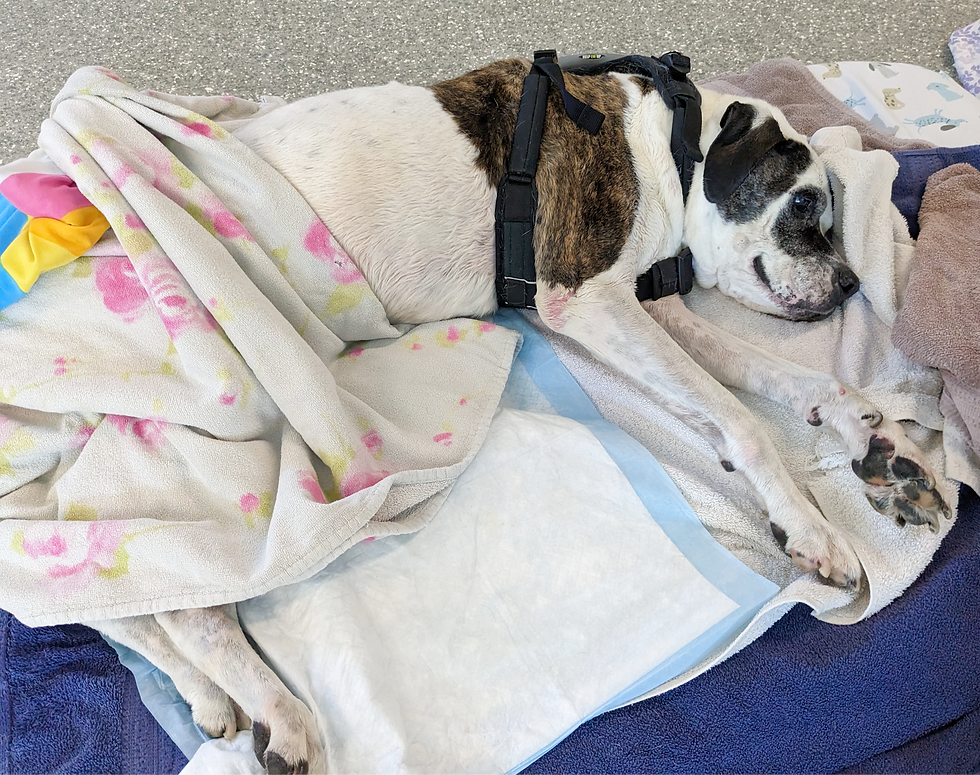
Bigger is better because the more pads you have to use to cover an area, the more edges there are where urine or feces can leak through.
Since your dog will be spending a lot of time in one area, they will need plenty of soft, cushioned bedding and that bedding is likely to become soiled at some point. Make your life easier and choose bedding/padding that can be layered and is easy to clean! For a more detailed breakdown and real life examples on this aspect of your pet’s care, visit our article How to Set Up a Recovery Pen.
Diapers & Belly Bands
Diapers are great for female dogs with fecal or urinary incontinence, but are really only helpful for males with fecal incontinence. Disposable or reusable versions are readily available for purchase. Getting the right fit can be tough and your dog’s tail may complicate things. Even with the perfect fit, diapers tend to slide down and fall off, especially as they become full, which can be frustrating.

If you’re battling falling diapers, have your dog wear a comfortable harness & use pacifier clips to hold their diaper in place.
Wrap the loop around the harness & attach the clips to the diaper’s edge that sits over your dog’s back. Metal clips tend to work best.

Belly bands are super helpful for male dogs that have bowel control but are urinary incontinent. These wrap around the dog’s abdomen to hold an absorbent material over the penis so that urine is contained within the band. These come in both disposable and reusable versions. We find that the reusable ones tend to stay on better and are often more cost effective. We’ve prepared links for many of these items on our Gear & Resources page.
Line your pet's reusable belly band or diaper with human menstrual or incontinence pads! It's super easy to switch out pads rather than having to wash the band/diaper every time your dog urinates.

Regardless of what type of diaper or belly band you choose to use, you must be extremely careful to use them properly or you risk injury & infection.
Just like human babies, your dog’s diaper needs to be correctly sized and changed promptly once it has been soiled.
All areas of skin that come into contact with the diaper must be closely monitored. The skin around the groin area is particularly sensitive so a soiled diaper (bacteria) that is too tight (abrasive/cuts off blood flow) and is left on for too long (prolonged exposure to moisture) is the perfect storm for painful, infected wounds. Incontinent dogs are already at a higher risk for Urinary Tract Infections, but sitting in a dirty diaper will exponentially increase that risk.
When Possible, Get Outside
If your veterinarian deems it safe to do so, try to help your pet urinate and defecate outside as often as possible. It can be emotionally helpful to give them a break from the monotony of life in the recovery pet in favor of some sunlight and fresh air. Even if you are manually expressing your pet’s bladder, try to do it outside where your pet would normally potty whenever you can.
Your pet will always prefer to eliminate in a separate space from their den area.
Washing Up
Regular, prompt changing of bedding and diapers/belly bands is a great place to start, but you’ll need to address their skin and coat as well.
If your dog has a long/thick coat, shaving the hair around their anus & genital area, aka a Sanitary Trim, makes clean up much easier!
Unscented baby wipes work well in a pinch but soapy washcloth is often more effective. Frequent wiping or washing can irritate your pet’s skin so we recommend using an oatmeal or sensitive skin pet shampoo to prevent overly dry skin.
If you intend to use wipes on a regular basis, make sure to buy wipes that are formulated specifically for dogs, as their skin pH is different from ours.
Sometimes, a complete bath may be necessary. If so, just make sure your dog cannot slip or fall in the bath and that they are thoroughly dried after. Skin that is allowed to remain dirty and/or moist for too long is likely to develop a rash or infection.
About “Waterless” Shampoo...
Often sold as a blue liquid spray product, Waterless Shampoo can be somewhat helpful for very minor messes, but doesn’t actually wash your pet’s skin or coat since there’s no rinsing after!
It does not replace actual bathing, can create skin irritation with frequent use, & can even stain your pet’s coat blue.
Keep in mind that dogs have a primal need to maintain some level of cleanliness and for their den to be free of waste. Dogs that are left in dirty bedding/diapers can develop significant stress, anxiety, and even depression. None of these are conducive to healing, so remember that keeping your dog clean and comfortable will also help keep their mental state healthy which will help support their physical recovery and Quality of Life.
Neurogenic Bladder & Urinary Tract Infections
Dogs with spinal cord injuries often experience urinary dysfunction as well & the more time the pet spends unable to urinate normally, the higher their risk for developing Urinary Tract Infections (UTI).

For some patients, the bladder becomes flaccid and the pet urinates involuntarily, however that doesn’t mean they are completely emptying their bladder. Often, the bladder remains partially filled and requires manual expression to completely empty, else “old” urine is left to sit and the bacteria within it will proliferate. Other patients may have too much urinary sphincter tone, preventing the bladder from emptying. These pets must receive timely medical intervention or serious complications like kidney damage, bladder rupture, or even death can result.
Depending on your pet’s needs, your veterinarian may teach you how to express your pet’s bladder so that you can do it as often as needed at home but you should never attempt to do this without instruction from your pet’s veterinarian.
If you believe for any reason that your pet may be unable to urinate & you are unable or have not been instructed how to express their bladder, you should seek veterinary care immediately.
Keeping your pet clean & dry will go a very long way to help reduce risk, but you should remain vigilant for common signs of UTI.
These signs include:
Excessively stinky urine, especially a fishy odor
Urine that is darker in color
Pink tinged or bloody urine
Discharge from the urethra
Pain while urinating
Excessive licking of penis/vulva
Increased thirst
UTI is diagnosed via Urinalysis & if possible, it’s best to have a Culture & MIC performed as well, as this specifically identifies the type of bacteria that caused your pet’s infection & the antibiotic that is mostly likely to kill it.
You should never assume that your pet’s UTI is gone just because they finished a course of antibiotics.
Should your pet be diagnosed with a UTI, always be sure to completely finish the prescribed course of antibiotics AND have a follow up Urinalysis performed to ensure no infection remains.
Their symptoms may have improved enough for you to believe they’ve been cured but the initially prescribed course of treatment isn’t always enough to completely eradicate the bacteria that caused the infection. If any of that bacteria remains when you’ve finished giving antibiotics, it will repopulate and your pet’s symptoms will return. Worse yet, the bacteria that survived and repopulated is significantly more likely to be resistant to first line antibiotics, meaning that your pet will require stronger medications that may have more side effects for a longer period of time to be cured of their UTI.
Protecting Skin & Paws
Urine Scald
When the skin is exposed to urine for a prolonged period of time, the ammonia and other components of urine will damage the skin’s protective barrier, causing it to become raw and painful.

Accidents or soiled diapers must be addressed promptly & the skin should be allowed to breathe on a regular basis.
The longer the skin remains moist and exposed to irritants, the weaker it becomes, the higher your pet’s risk for infection and open wounds.
Urine scald is 100% preventable by ensuring that your pet’s skin & coat is kept clean & dry.
Urine scald is easily identified, as the skin becomes very obviously inflamed and the pet’s coat develops staining and odor that are difficult to remove. Many pets will begin licking the area in an attempt to remove the source of their discomfort, which can also result in staining of the coat and introduce infection.
If your pet develops Urine Scald that doesn’t quickly resolve from improved hygiene practices, your pet may also need oral and/or topical medication to address infection and pain.
If your pet’s coat is particularly long or thick, shaving or trimming it back can be immensely helpful to make clean up faster and easier in addition to allowing more air flow to reach the skin, helping to keep it dry. Sometimes, an e-collar (the cone of shame!) may be necessary to prevent your pet from licking the skin while it heals.
Failure to treat & prevent urine scald can also contribute to our next topic, Decubital Ulcers.
Decubital Ulcers (aka Bed Sores)
More commonly referred to as Bed Sores or Pressure Sores, Decubital Ulcers are painful wounds & a serious concern for the Recumbent Dog.
If the body remains in one position for too long, the soft tissues in the areas where bones are most prominent will experience too much pressure and too little circulation. These tissues then begin to break down, forming open wounds. Combine open wounds with urinary/fecal incontinence and we’ve got a recipe for a nasty infection. If allowed to continue, these wounds can become so deep that they expose muscle, tendon, or even bone.
Common Decubital Ulcer Locations

Decubital ulcers are most likely to form on the bony parts of the body that experience the most pressure when laying on their side. Commonly affected areas include ankles, hips, elbows, shoulders, and eyebrow area, but these can occur anywhere that experiences prolonged pressure. Early stages can look like patches of hair loss or pink skin. If pressure is not relieved, the skin will begin to break down. You may also see redness, swelling, and discharge from the developing sore.
Decubital ulcers that are allowed to worsen can eventually become full thickness wounds that expose muscle, tendon, or even bone.
Decubital Ulcers can be very difficult to heal once they form, but they are very preventable! Make sure your dog has plenty of cushy padding (see our Recovery Pen article) and most importantly, that they are repositioned every 4 hours if they cannot do so themselves. If your dog urinates or defecates on themselves or their bedding, they should be washed promptly and their bedding should be changed out right away. Again, make sure they are thoroughly dried before being returned to their resting place. Skin that is kept moist for a prolonged period will also be more fragile.
If your dog cannot reposition or roll themselves over to their other side, you will need to reposition them every 4 hours.
When repositioning your pet, make sure to rotate between multiple positions and regularly switch sides of the body. Use rolled up towels or limb spacer pillows to help support your pet’s body and prevent them from rolling over. Not all positions are appropriate, so be sure to consult with your Rehab specialist for specific recommendations.


If deemed safe for your pet, sternal positioning is a great alternative to always laying on their side & makes it easier for them to eat, drink, & interact.
When laying your pet on their side, make sure to provide extra cushioning between their legs so that they are parallel to each other.
This will help prevent decubital ulcers & overly tight muscles that could hinder their return to mobility.


Abrasions
If your dog is dragging themselves around, they are at high risk of developing wounds, even if it's on a soft surface. If your pet’s veterinarian has deemed it safe for your pet to drag themselves around, you’ll need to protect the areas of their body making the most contact with the ground to avoid injury.

There is a common misconception that it is safe for dogs to drag themselves on soft surfaces like carpet, but we see many patients that are allowed to do so develop abrasions over their pubic bone or paws and they often present with excessively worn toenails that bleed. Drag bags are a great tool for these situations and can help contain any mess that results from a slipped diaper.
When assisting your dog with a sling or Help ‘Em Up Harness, you’ll still need to mind their feet. There are many different booties on the market, and like us, every dog’s feet are unique so you may need to try a few different kinds to find which ones work best for your dog. As with anything you put on or around your pet, take care to ensure your pet doesn’t eat them and that they are not left on for too long.
All of these items are found on our Gear & Resources page, but we’re always happy to provide personalized recommendations to CROC clients. For more information about getting your recumbent pet up and moving, including choosing the right gear for your circumstances, visit our article Rehabbing Recumbency.
How to Lift & Carry Your Dog

If your dog can’t walk because of a spinal injury, it is imperative that you lift and carry them in a specific manner so as to avoid any further injury or pain.
The most important thing is to make sure their spine remains parallel to the ground at all times.
This is most easily accomplished using both arms to do the “lamby lift”or using a Help ‘Em Up Harness. Both methods provide equal support under the chest and pelvis and keep the pet’s legs directly underneath them. You should never pick up your pet by their armpits or allow their spine to twist or hang in any direction. Put them down in the same manner, keeping their spine parallel to the ground.
Harnesses & Slings
A good harness will be one of the most important things to help you safely move and restrain your dog, but it can be tough to pick the right one out of the millions of options because many aren’t made with ergonomics or safety in mind. Look for one that has a Y-shaped front and the leash attachment point should be on your dog’s back. Be sure to avoid harnesses with a strap horizontal in front of the chest, step-in style harnesses, and “no-pull” harnesses or those with a section that tightens with pressure.

Our favorite harness for dogs that are unable or struggle to walk on their own is the Help ‘Em Up Harness because it supports the entire body - no sling required - and it’s more comfortable for long term use. It can be tricky to find the right size and then adjust all the straps to fit your dog, but check in with our team and we can help you with that! Our Gear & Resources page also includes examples of traditional harnesses that we've found work well for our patients.
A sling can be as simple as a towel or a neck tie but dog specific slings are also available online or in big box pet stores.
No matter what you use, just make sure that it is made with soft material & does not inhibit movement - if your dog can move their back legs even a little, we don’t want anything getting in their way! Some male dogs can find it difficult or impossible to urinate with certain slings, so you may need to try one that sits farther forward or backward on their belly.

That’s another reason we like the Help ‘Em Up! Almost all sizes have the option of a U-band for male dogs that cannot comfortably urinate with a sling. Lastly, make sure you choose a sling with handles that can be adjusted to your height. Your ergonomics matter too!
Collars can be worn as an accessory to hold identification tags, but should never be used to move the recumbent pet or any pet with a history of or predisposition to spinal injury.
When using a harness and/or sling to move your dog outside to potty, follow the same rules as when lifting them. Support the entire body and keep their spine parallel to the ground - do not allow their spine to twist in any direction. Walk slowly and allow them to move their legs/paws as much as they are able. Even if their legs aren’t moving at all, as long as their feet are protected from injury, just the act of imitating walking is very helpful in working towards recovery.
To learn more about getting your pet moving and additional gear to make life easier, visit our article Rehabbing Recumbency.
Quality of Life for All
We touch on this subject for your sake as well as your dog’s. Compassion fatigue is a prevalent concern for clients caring for recumbent dogs. Especially if their paralysis becomes more advanced or they lose control of their bowels and bladder, the strain on you to keep them clean and safe, as well as the physical strain of carrying them around is enough to wear down even the most dedicated owners. We bring this up because we want you to know that we are available to you as you navigate your pet’s condition.
We frequently support our clients through the big decisions & help them to find the plan that works best for them while keeping quality of life as high as reasonably possible for all involved. At any time during your pet’s journey, we completely understand & support humane euthanasia as an option.
When deciding “when it’s time”, it’s always best to go weeks or even months too early than a day too late.
Make sure to be realistic with your resources (finances, time, and energy) and frequently check in with yourself. Are you still enjoying your dog’s company? Are they happy and still enjoying their favorite activities? At any point, are you building resentment for the amount of work your dog now requires?

It is important to note that for any end of life evaluation,
the fact that an animal continues to eat is NOT a significant enough reason to delay euthanasia
if other aspects of their life are filled with suffering. If you would like more information about how to properly evaluate Quality of Life for you and your pet, please feel free to reach out to us for assistance or read our article discussing Quality of Life.
We're here for you
Overall, caring for the recumbent/non-ambulatory dog is a tall order. There's a lot to consider when deciding how to move forward, but having realistic expectations for yourself and your dog can help make the situation a bit easier to manage. The CROC team is here to support you and offer advice at any time during your pet's journey but it's also a good idea to find support with your regular veterinarian and others within your household.


